Energy data for Luxembourg
last updated: 2026-01-03
Energy data for a house in the midst of Luxembourg
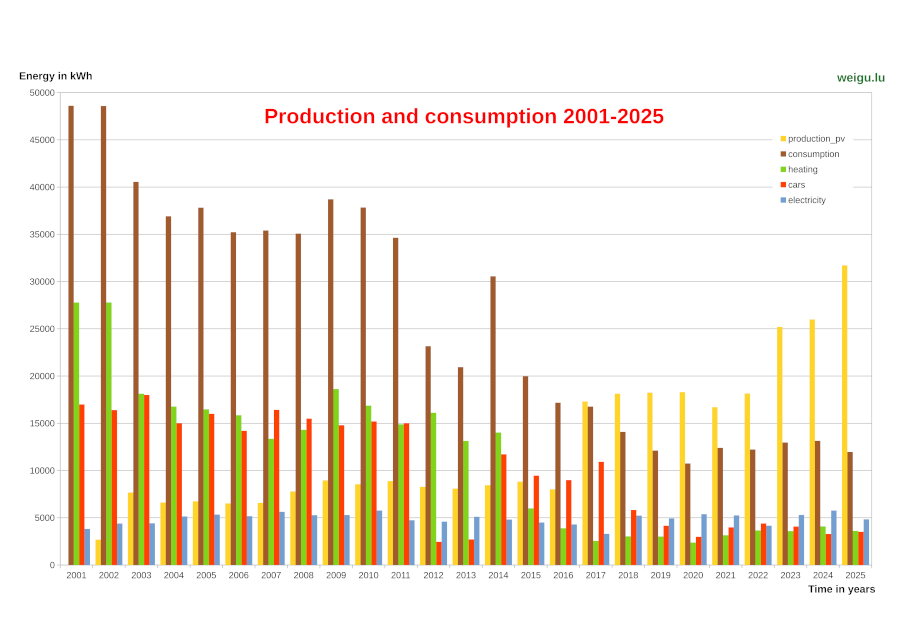
Here you see that converting from fossil energy sources to renewable electric energy reduces the overall energy needed by about two thirds.
The efficiency of heat pumps and electric cars is at least three times higher than that of fossil fuel heating systems and vehicles.
Production vs consumption 2001-2025
The following graph shows the consumption of a household starting in 2001. The house got isolated. The living space of the house (100m²) was also more than doubled (2002). The number of residents rose to 6, before declining again from 2022 onwards.
The heating (gas) was replaced with a heat pump in 2014. The fossil cars were replaced by electric cars (2012/2018).
Photovoltaic (PV) data Mersch/Luxembourg
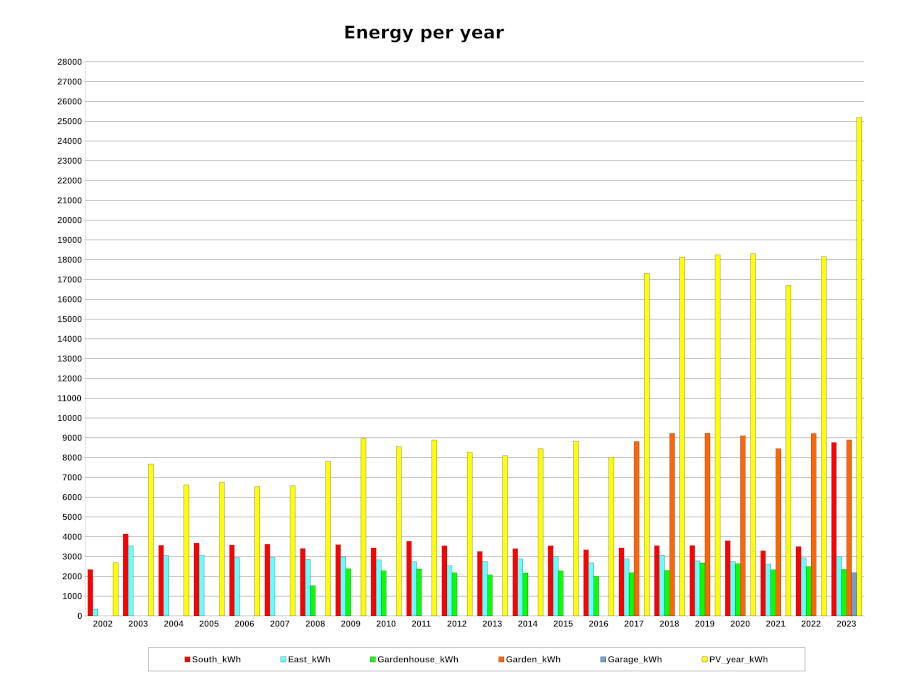
The following PV data is showing that this form of energy is technically mature. The units (approx. 150 m²) are producing more than double of the energy needed. This includes the energy for heating (heatpump) and two electric cars.
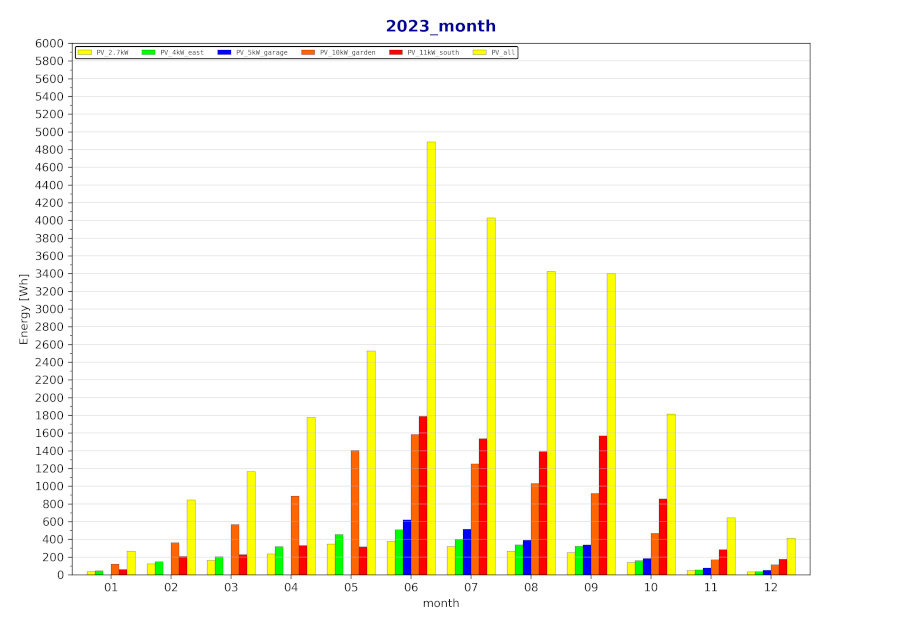
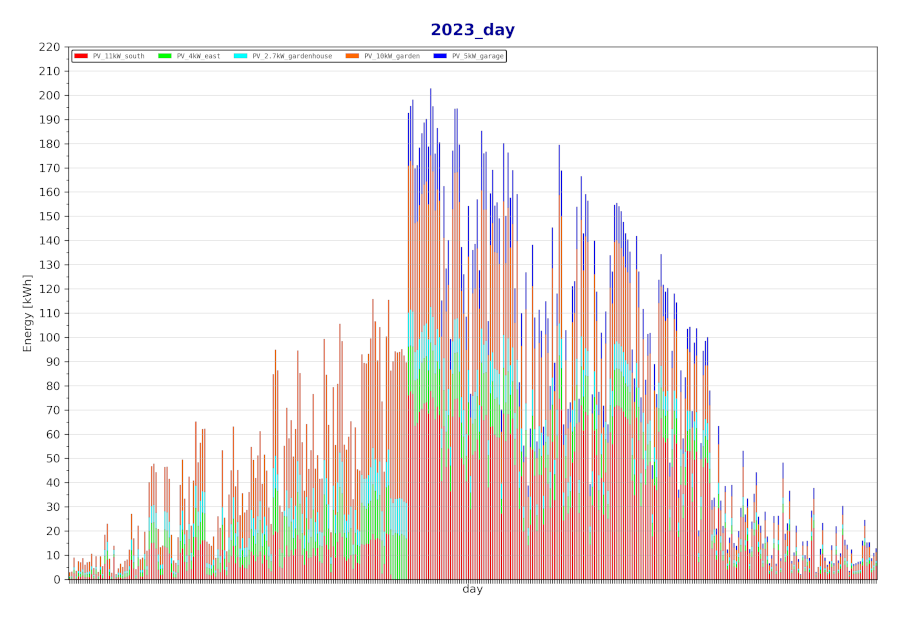
The data is aimed to help comparing different PV units, and to give an overview of the solar radiation in Luxembourg.
Yearly PV data:
Monthly PV data:
Daily PV data:
More infos
2025
End 2025 I mounted a part of the old PV panels from 2002 on the north side of the garden shed and another part is mounted vertically on a fence facing east.
- Unit 2026: 3 kWp (orig. 4 kWp)
1 part: angle of inclination 19°, azimuth +180° (north)
2 part: angle of inclination 90°, (east)
Sunny boy 3kW converter, AC output ESS 1p
2022-2023
In 2022 I installed a battery (48 V, 60 kWh) and an 3 phase 24 kVA energy storage system (ESS) from Victron.
A 4 kWp unit from 2002 on the east roof was disconnected from the grid in August 2022 and reconnected to the battery (DC-DC). In June 2023 I replaced the 4 kWp from 2002 on the south roof with a new 11 kWp unit (connected to the battery). I also added a 4.9 kWp unit on the garage (battery) and disconnected a 2.7 kWp unit from the grid and reconnected it to the battery.
So after 2023 four units (4 kWp, 2.7 kWp, 11 kWp and 4.9 kWp) are connected to the battery and one unit (10 kWp from 2017 is connected to the output of the ESS system (DC-AC, 3 phase).
- Unit 2002: 4 kWp, angle of inclination 30° azimuth -75° (75° east) to battery
- Unit 2008: 2.7 kWp angle of inclination 19° azimuth +15° (15° west) to battery
- Unit 2017: 2x5 kWp angle of inclination 10° azimuth +90/-90° (east/west) to AC output ESS 3p
- Unit 2023: 11 kWp, angle of inclination 45°, azimuth +15° (15° west) to battery
- Unit 2023: 4.9 kWp, angle of inclination 45°, azimuth +15° (15° west) to battery
Before 2023
For the data on this page before 2023 (no battery):
- Unit (WG) 2002: 4 kWp, angle of inclination 45°, azimuth +15° (15° west)
- Unit (WP) 2002: 4 kWp, angle of inclination 30° azimuth -75° (75° east)
- Unit (WK) 2008: 2.7 kWp angle of inclination 19° azimuth +15° (15° west)
- Unit (AU) 2017: 2x5 kWp angle of inclination 10° azimuth +90/-90° (east/west)
Failures:
- In August 2018, the inverter of the WK system died. Outage for 15 days. The outage amounts to around 150 kWh.
- In 2016 there were some problems with the loggers. The daily values are therefore not complete.
- On 16 January 2011, a module of the eastern plant went bye-bye due to a hotspot (plant WP). This went unnoticed until 21 April, as the second string continued to supply energy. On the same day, the module was replaced free of charge (warranty). The loss amounts to around 360 kWh.
- On 06 August 2012, the inverter of the east system gave up. It was replaced on 22 August. The loss amounts to around 250 kWh.
